PRODUCTS & TECHNOLOGY · INTELLIGENT OCEAN

数智海洋

A perceivable, knowable and manageable intelligent ocean system built on 5G, big data and cloud computing.

SYSTEM OVERVIEW · OVERVIEW

An intelligent-ocean system matrix from perception to decision

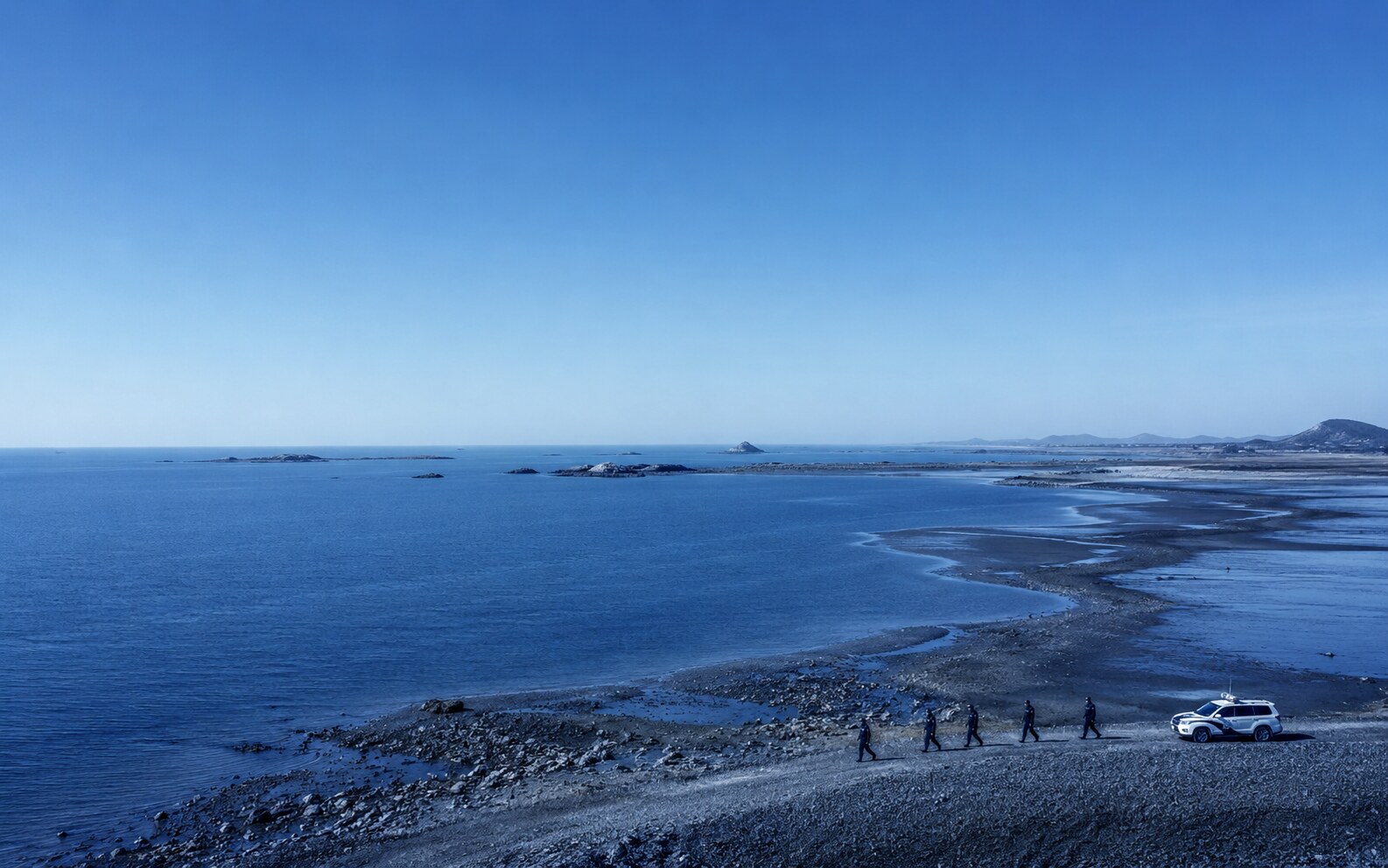
Intelligent Ocean centers on marine ranches, fishing ports, the integrated observation network, coastal early-warning surveillance and ecological patrol, building end-to-end capabilities across perception, transmission, data, platform and decision — so every sea area can be continuously observed, understood and managed.

01 / FLAGSHIP

Marine Ranch Management System

Marine Ranching Management

Built on GIS, electronic maps, IoT, cloud computing, 3D visualization and database technologies, and tailored to the characteristics and requirements of marine-ranch construction and management, the system delivers a "single-map" management of integrated marine-ranch information, recreational sea-angling management, stock-enhancement release management, fishery-resource surveys, marine-environment analysis, ecological early warning, 3D virtual display of the marine ranch, and visual command and dispatch.

It provides a full picture of the ecological status, fishery-resource status and production-operation status of marine ranches within the jurisdiction, guiding the scientific implementation of quota-based harvesting and stock-enhancement release. It makes operations information-based, analysis intelligent, early warning timely, dispatch clustered and auxiliary functions interconnected — improving the speed and efficiency of responding to marine ecological disasters, strengthening marine-ranch oversight, and supporting the intelligent upgrade of marine ranches.
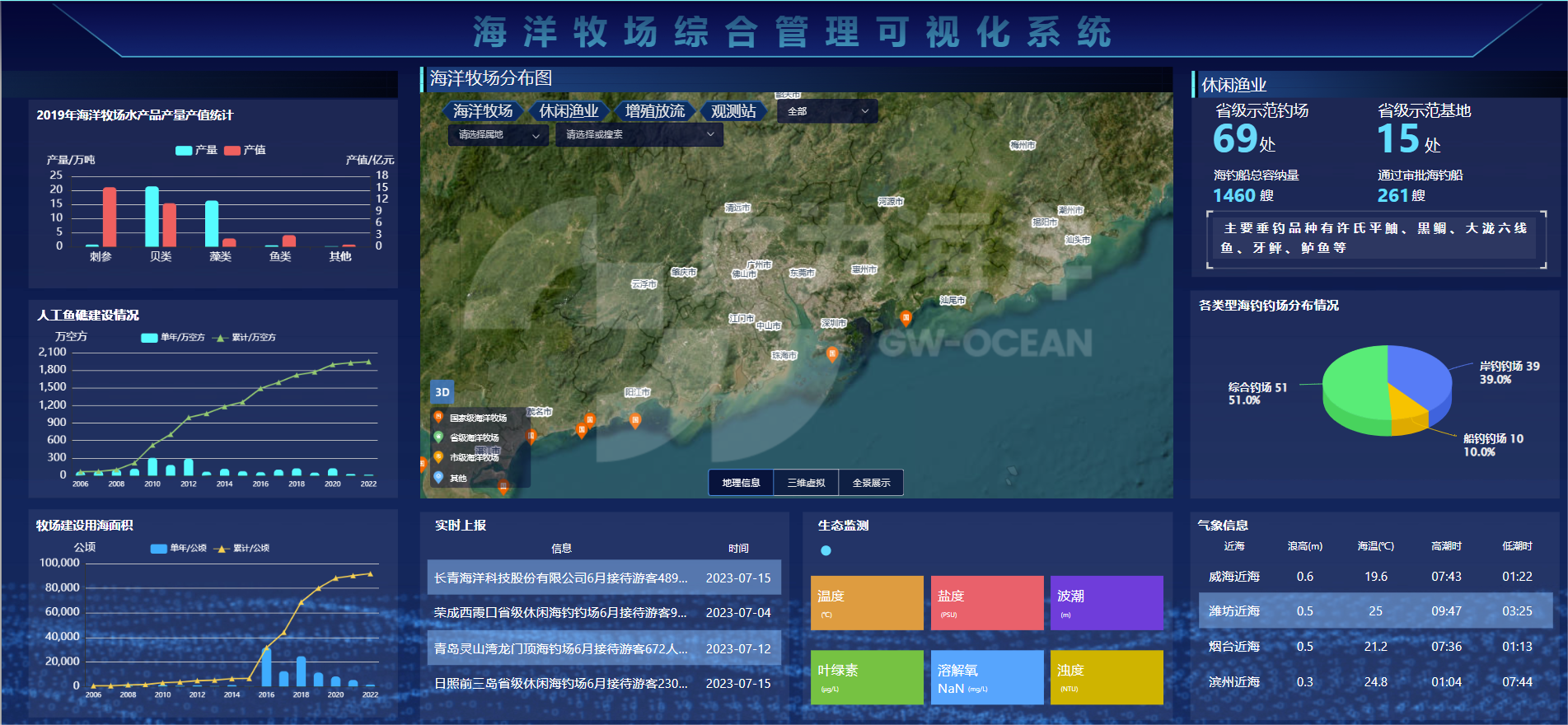
Marine-ranch information management

Manages data on the various vessels, equipment and facilities such as deep-water net cages, projects under construction, recreational fishing grounds, visitor reception and the production and sales of marine delicacies within the marine ranch, generating production-operation reports for the marine ranch.

Recreational fishery management

A B/S-architecture responsive map of fishing-ground distribution, covering safety management of recreational sea-angling vessels, positioning management, departure permits, dock surveillance, dynamic management of anglers and monthly operation reports — safeguarding fishing-port facilities, vessels and personnel.

Marine biological resource survey

Integrates marine-resource big data to aggregate and assess data from coastal fishery-resource surveys, harvesting-production monitoring, stock-enhancement surveys, marine-ranch monitoring, dedicated economic-resource surveys, and effectiveness evaluation of summer fishing-moratorium conservation.

Marine environment monitoring and early warning

Continuously monitors temperature, salinity, dissolved oxygen, chlorophyll and other parameters via observation stations, observes the sea-area environment and species status through surveillance video, and aggregates the analysis to issue disaster early warnings for advance disaster prevention.

Data acquisition and analysis

Collects marine observation, production-operation and meteorological data along with sea-area environment, marine-biology and water-quality parameters released officially at national and provincial levels, performing big-data aggregation and analysis to support disaster prediction, resource assessment and scientific decision-making.

Visual command center

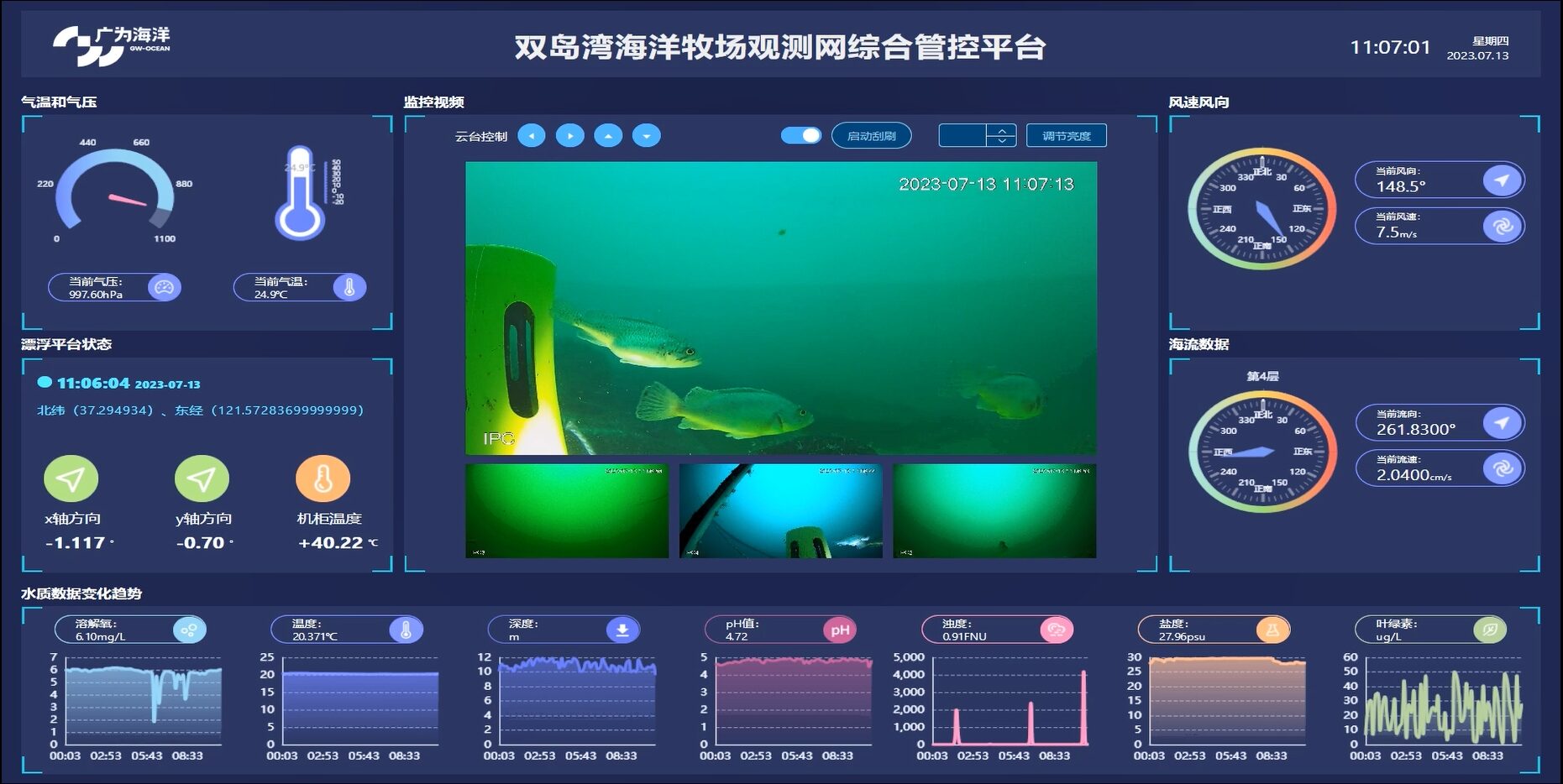
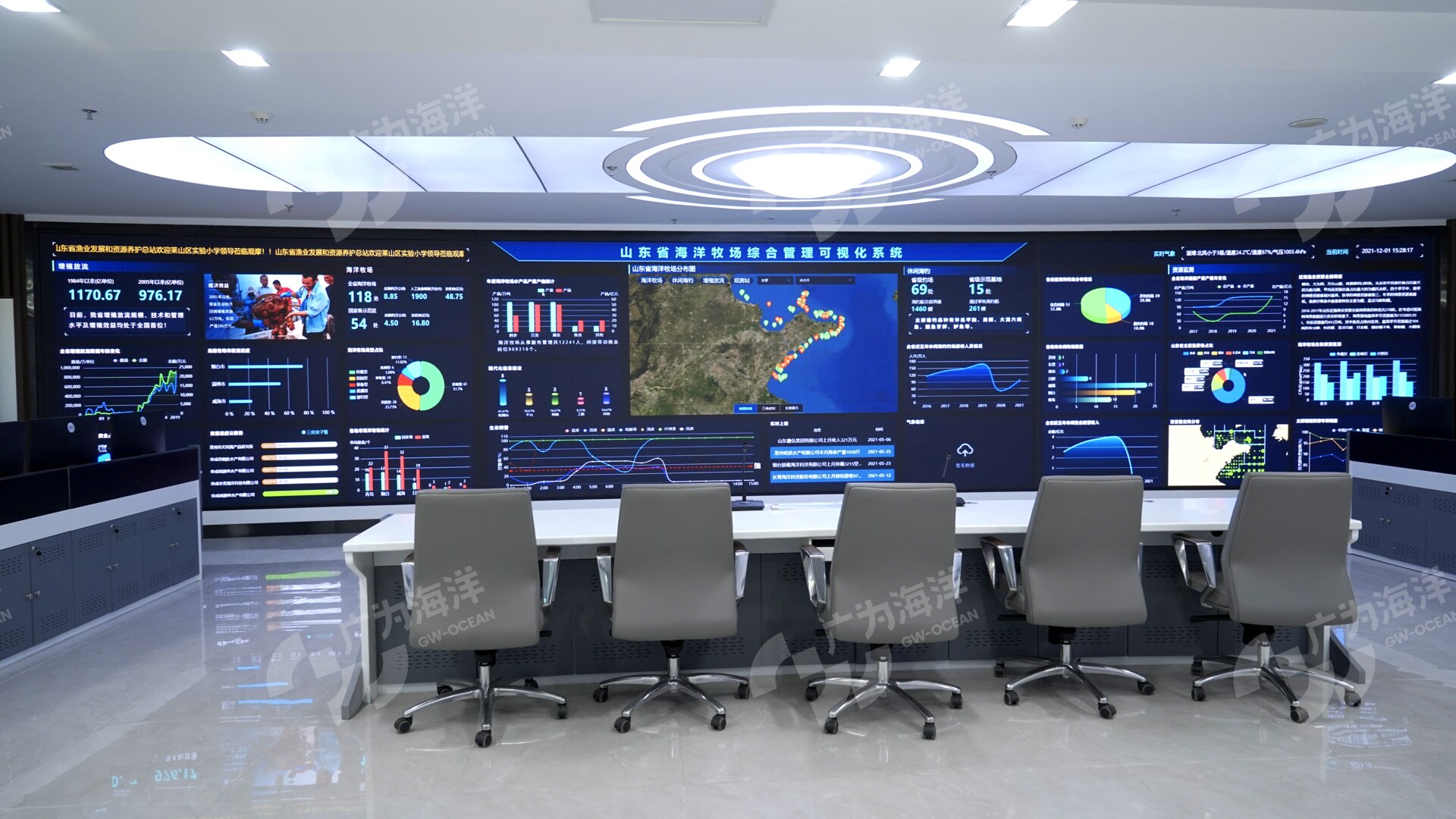
Through computer control and large-screen display, data collected by various observation devices and construction-operation data are categorized, aggregated and displayed by zone — a support window for production-operation management, command and dispatch, and scientific decision-making.

Marine ranch visual command center
Visual command center: observation data and operation data are displayed by zone, supporting production management and scientific decision-making.

02 · INTEGRATED OBSERVATION · OBSERVATION NETWORK

Marine Ranch Integrated Observation Network

Independently developed and designed by Shandong Guangwei Marine, the marine-ranch integrated observation network comprises a seabed observation platform, a surface-mounted platform, a marine-ranch intelligent management system, a data acquisition and analysis center, a radar–electro-optical surveillance system, offshore personnel safety management, a mobile app and other modules — enabling tracking and monitoring of the marine ranch’s ecological environment and resource status, as well as intelligent management of its operation and maintenance.

Marine Ranch Integrated Observation Network
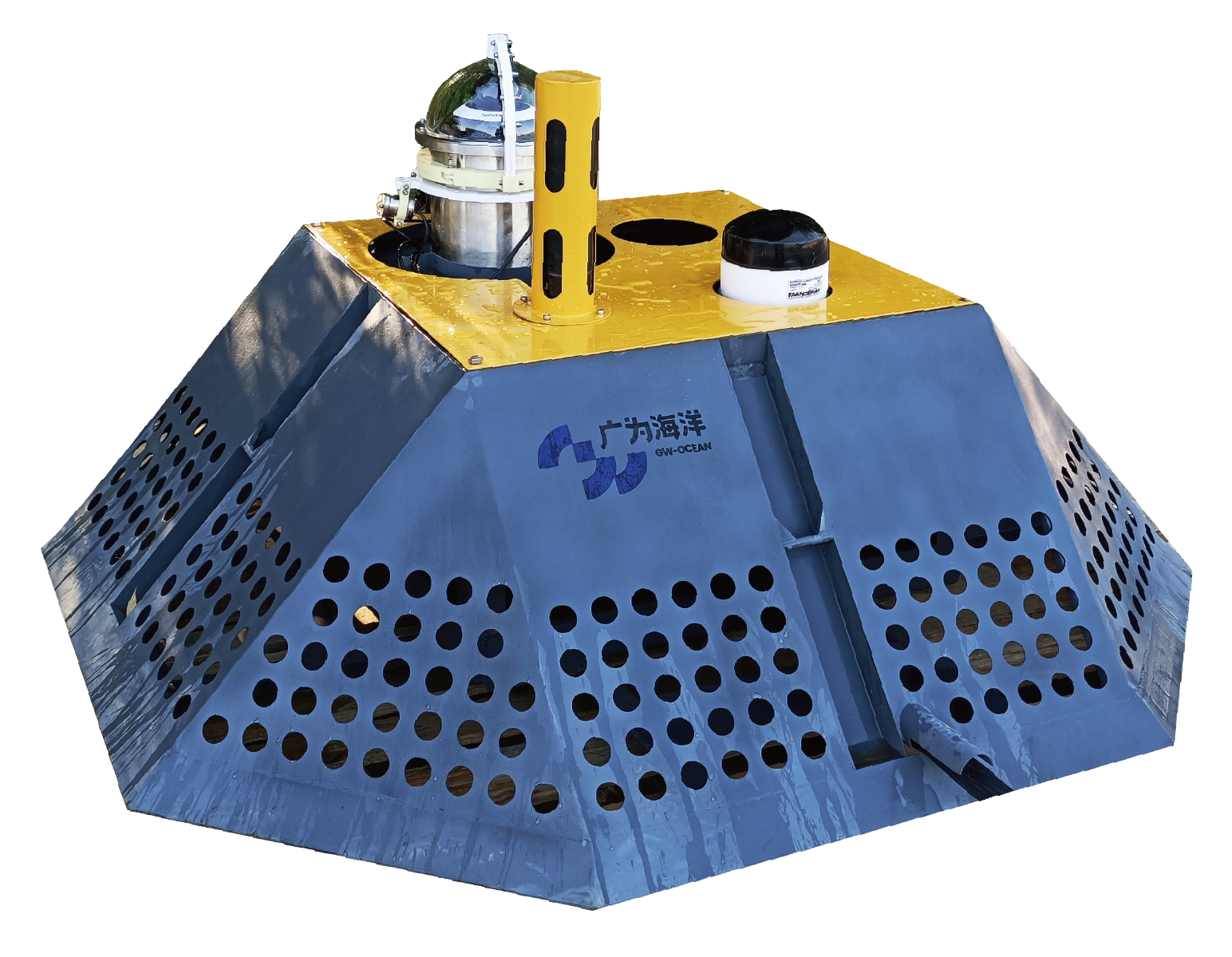
Seabed observation platform
Seabed observation platform: long-term continuous online monitoring of the underwater environment.

Seabed observation platform

Integrates hydrological, water-quality and hydrodynamic sensors, an underwater HD camera and LED fill lights for long-term continuous online monitoring of the underwater environment; high protection rating, strong wave and corrosion resistance, structural stability, easy deployment, strong scalability and low maintenance cost.

Surface-mounted platform

Integrates an intelligent spherical camera, a shore-based weather station, a microwave base station and an omnidirectional antenna to collect temperature, humidity, air pressure, wind speed, wind direction, rainfall, radiation and ultraviolet parameters — enhancing meteorological-disaster monitoring and early warning while serving mariculture, marine sightseeing and recreational angling.

Radar–electro-optical surveillance

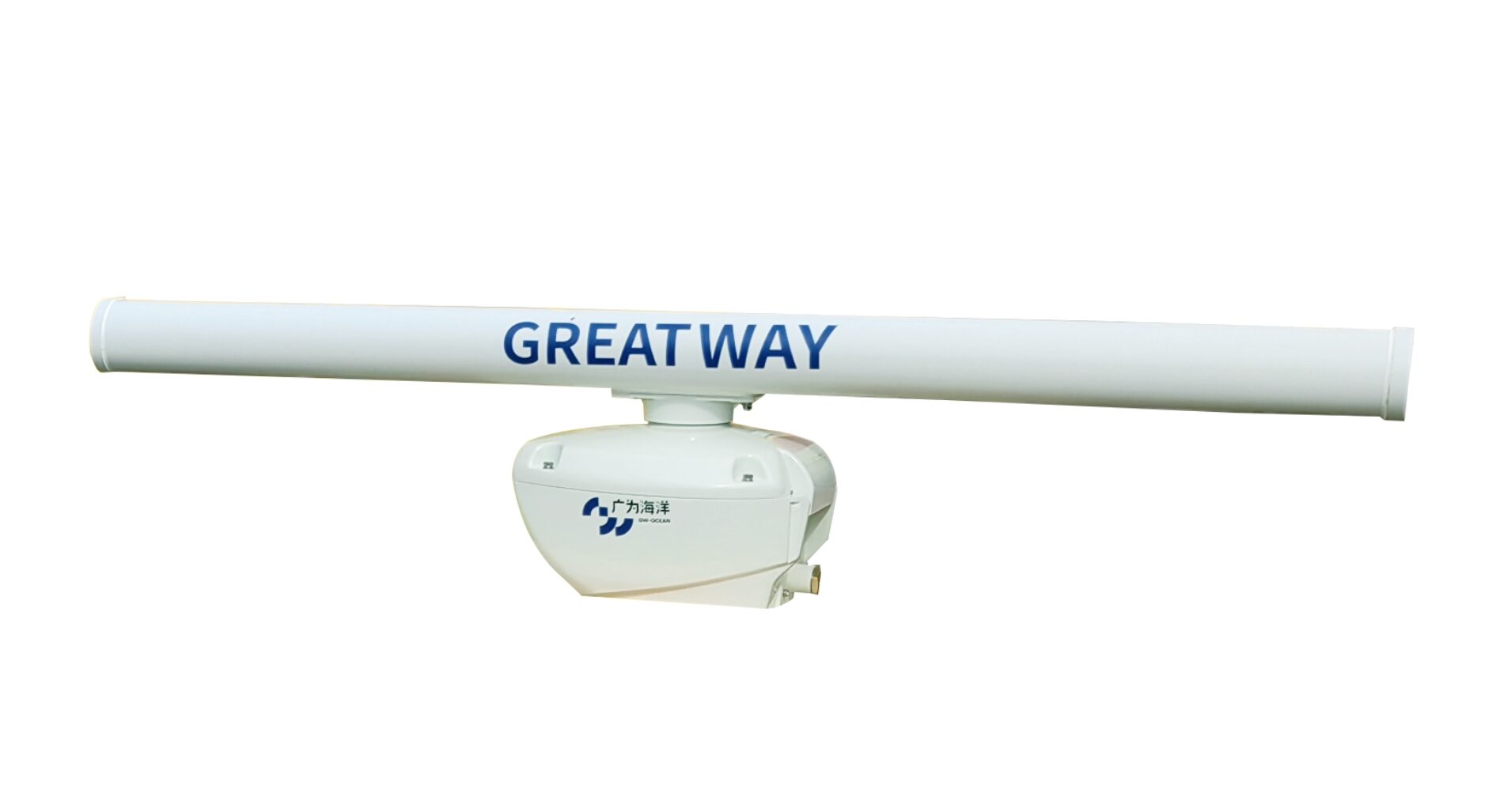
Fuses radar and electro-optics, infrared cameras, AIS vessel identification and satellite maps; through radar–electro-optical interlinkage, it performs all-weather, wide-area, fully automatic target detection and tracking across the marine ranch.

Offshore personnel safety management

Provides marine-ranch production-personnel management, personnel safety positioning, electronic attendance, electronic fence and emergency personnel search and rescue — serving marine-ranch production management.

Intelligent management platform

Comprehensively manages and displays foundational data, environmental observation data, production-operation data, marine-meteorological data and third-party sea-area environment, marine-biology and water-quality parameters as big data — building a transparent marine ranch that is visible, measurable and controllable.

Mobile app

Supports mobile-app login, accessing marine-ranch observation data in real time for online processing and analysis, with features such as observation-station distribution, real-time data monitoring, surveillance-video playback and online early warning.

03 · OFFSHORE WIND · OFFSHORE WIND SPILL

Offshore Wind Farm Oil-Spill Monitoring & Alarm System

As China’s energy strategy advances, offshore wind power is booming. Leaks of wind-turbine gear oil and hydraulic oil not only affect normal turbine operation but may also pose risks to the marine ecology. The National Energy Administration has released the industry standard "Technical Specification for Oil-Spill Monitoring in Offshore Wind Farms (NB/T 11760-2025)," effective December 30, 2025. GW-OCEAN’s offshore wind-farm oil-spill monitoring and alarm system consists of two subsystems — a UV-fluorescence spill monitoring and alarm system and a radar spill monitoring system — combining the "point" (turbine point source) and the "surface" (wind-farm sea area) in non-contact remote-sensing monitoring, to deliver early warning of turbine leaks and real-time tracking of spills that have already occurred.

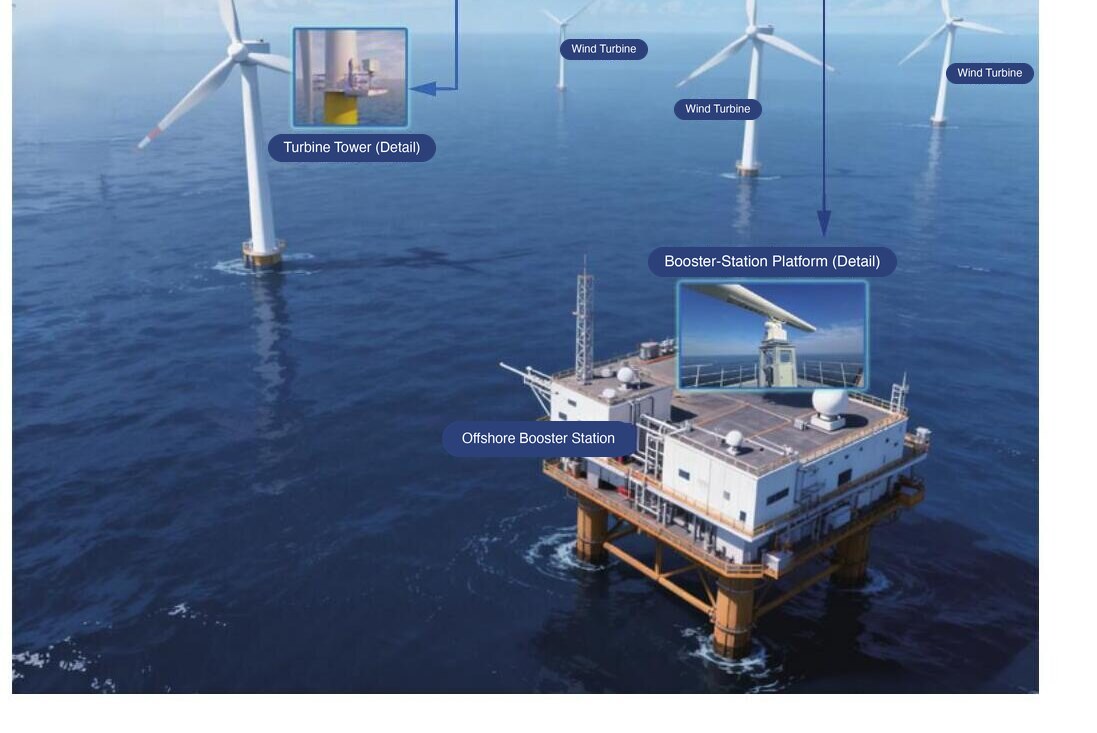
Composition of the offshore wind-farm oil-spill monitoring and alarm system
System composition: UV-fluorescence spill monitors are installed on the outer side of the turbine towers (the "point"), while the spill-monitoring radar is mounted on the offshore booster-station platform (the "surface"); monitoring data is relayed to the monitoring center over fiber and GPRS wireless communication.

UV-fluorescence spill monitoring & alarm (the "point")

Multiple monitoring terminals deployed on the outer side of turbine columns form a distributed sensor network for round-the-clock monitoring of hydraulic- or gear-oil leaks on the sea surface near each turbine; each terminal relays data with low latency over GPRS wireless, fiber or a dedicated Internet network to a shore-based central server, where operators confirm the data, analyze oil-film tracks and start or stop the audible-visual alarm.

UV-fluorescence detection principle

A built-in xenon lamp emits pure ultraviolet light of a specific wavelength straight down onto the sea surface; oil-film molecules absorb the UV light and are excited to release a distinctive characteristic fluorescence, which an optical lens precisely captures and a photomultiplier amplifies — achieving highly sensitive identification and alarm of trace oil pollution. (316SS · IP68 · explosion-proof Exd ⅡB T6 · detection range 0.2–15 m · MODBUS)

Radar spill monitoring (the "surface")

Mounted on the booster-station platform and covering the full distribution range of the wind farm’s turbines, the spill-monitoring radar uses S/X-band antennas for all-around scanning, with a professional data processor acquiring low-level echo data in real time; an integrated signal aggregator synchronously fuses the radar data with on-site GPS navigation, wind speed/direction, ship-compass and other meteorological and environmental data (NMEA protocol).

Radar imaging & spill extraction

Raw radar signals are converted into intuitive 2D images; environmental clutter such as waves, rain and snow is intelligently filtered out (noise suppression); a sea-surface background baseline is established to precisely lock onto abnormal echo areas (echo fitting); and the characteristic "dark zone" of oil pollution is identified to directly extract a clear spill outline — automatically delineating the oil film, computing its position and area, and raising an alarm.

Key performance

X-band solid-state radar, IP65, meeting IEC 60945; monitoring range (radius) ≥15 km; minimum detectable spill area 10 m × 10 m, with spill-patch positioning ranging error ≤±2% and azimuth error ≤0.2°; the distribution area, oil-film thickness and drift trajectory of sea-surface spills can all be tracked.

System advantages

Point-and-surface non-contact remote-sensing monitoring — efficient and safe; real-time, around-the-clock monitoring with long service life; all-time, all-weather monitoring adapted to complex environmental conditions; and automatic monitoring of sea-surface oil pollution and hazardous chemicals with automatic alarm — providing vital information support for emergency response.

04 · SMART FISHING PORT · SMART FISHING PORT

Smart Fishing Port Management System

The system collects foundational data on fishing ports, vessels and crew to achieve orderly management and scientific use of data, building a smart fishing-port service system that integrates personnel management, emergency management and analytical services. It upgrades the command center’s emergency-command facilities accordingly, comprehensively strengthening fishery safety supervision and making the management of fishing vessels, fishing ports and fisheries more refined, standardized and information-based — providing scientific decision-support for marine and fishery authorities and efficient, convenient marine information services for the public.

Smart Fishing Port Management System

Smart video surveillance

Uses high-and-low-point interlinked visible-light and thermal-imaging cameras together with AR panoramic smart cameras to deliver real-time preview, intelligent monitoring analysis and early warning for fishing-port safety supervision, vessel-movement monitoring, illegal sand-and-gravel mining oversight, in-port pollution monitoring, Enteromorpha (green-tide) control and monitoring of illegal construction in the port area.

Mobile law-enforcement

Enforcement personnel can query tasks, enforcement history, online surveillance, surveillance video and laws and regulations at any time, and upload on-site enforcement information in real time; AI recognition identifies unlicensed or license-misusing personnel, and the system provides map browsing, route navigation, positioning check-in and other spatial-location information.

Integrated radar · electro-optical · AIS surveillance

Combines a search radar, an HD electro-optical turntable and an AIS receiver in one unit, leveraging the wide-field search and multi-target tracking of radar–electro-optics together with the all-round vessel identification and reporting of AIS to monitor vessel targets across the water area.

Face and vehicle recognition for port access

The one-face-pass system covers visitors, access control, personnel channels and attendance; port-area vehicle management uses electric barriers and license-plate recognition modules to effectively manage incoming and outgoing vehicles.

Dynamic monitoring of fishing vessels and ports

A single-map of fishery information for integrated display, combining integrated services, information management, early-warning analysis, emergency management, equipment management, electro-optical interlinked applications and a mobile client — covering early warnings for electronic fences, abnormal weather, entry/exit statistics, off-site mooring, fishing-moratorium operation, "three-no" vessels, BeiDou removal, identity anomalies and more.

Visual command center platform

Combines big data, cloud computing, integrated control, large-screen display, audio pickup and amplification, digital audio conferencing and image access to provide information-data analysis, emergency-incident response, on-duty watch, contingency-plan management, training drills, collaborative consultation, command and dispatch, and emergency rescue.

Emergency command system

Provides unified command and dispatch of personnel, resources and equipment, covering pre-incident operation monitoring, multi-channel incident reporting, in-incident multi-level resource audio-video fusion and on-map command and dispatch, and post-incident summary analysis and review — including on-duty watch, structured contingency plans, collaborative consultation, mobile response and summary evaluation.

05 · SITUATIONAL AWARENESS · MARINE SURVEILLANCE

Coastal Radar–Electro-optical Integrated Surveillance System

With the rapid development of marine-resource exploration, offshore wind power, marine ranches and port construction, traditional supervision faces narrow monitoring coverage, a lack of detection means and low oversight efficiency — creating an urgent need for advanced technology to enable detection and perception and to build an all-weather, all-directional surveillance system.

Shandong Guangwei Marine’s sea-area radar–electro-optical integrated surveillance system combines radar and electro-optical equipment to detect, track, identify and monitor marine targets accurately and efficiently. With advantages such as fast tracking, wide coverage, long visual range, good night-vision imagery and clear, stable video, it is widely used in marine supervision.

  • Radar–electro-optical–AIS

    Offers fully automatic, continuous and stable multi-target tracking, intelligent alarms, and real-time storage and playback of radar video. The radar performs fully automatic, full-range, long-distance, small-target real-time detection, while the electro-optical system, guided by the radar, tracks, identifies and gathers video evidence on targets; it can work networked or independently, with flexible selection of radar, electro-optical equipment, an integrated target processor, and display-control and auxiliary equipment.

  • Marine electronic fence

    Draws monitoring areas on a satellite map and sets multi-level alert zones to build a marine electronic fence. It performs dynamic monitoring and intrusion detection of all kinds of vessels inside and outside the fence, displays movement tracks and issues early warnings, and records historical tracks, real-time coordinates, motion parameters and time — strengthening surveillance of key sea areas with electro-optical evidence collection.

  • Vessel positioning and tracking

    When the radar detects a target vessel, right-clicking the corresponding electro-optical device tracks it; the electro-optical device automatically positions the target and performs video tracking and evidence collection, with a free choice of daytime or infrared working mode.

Featured Case

10 / FUSION

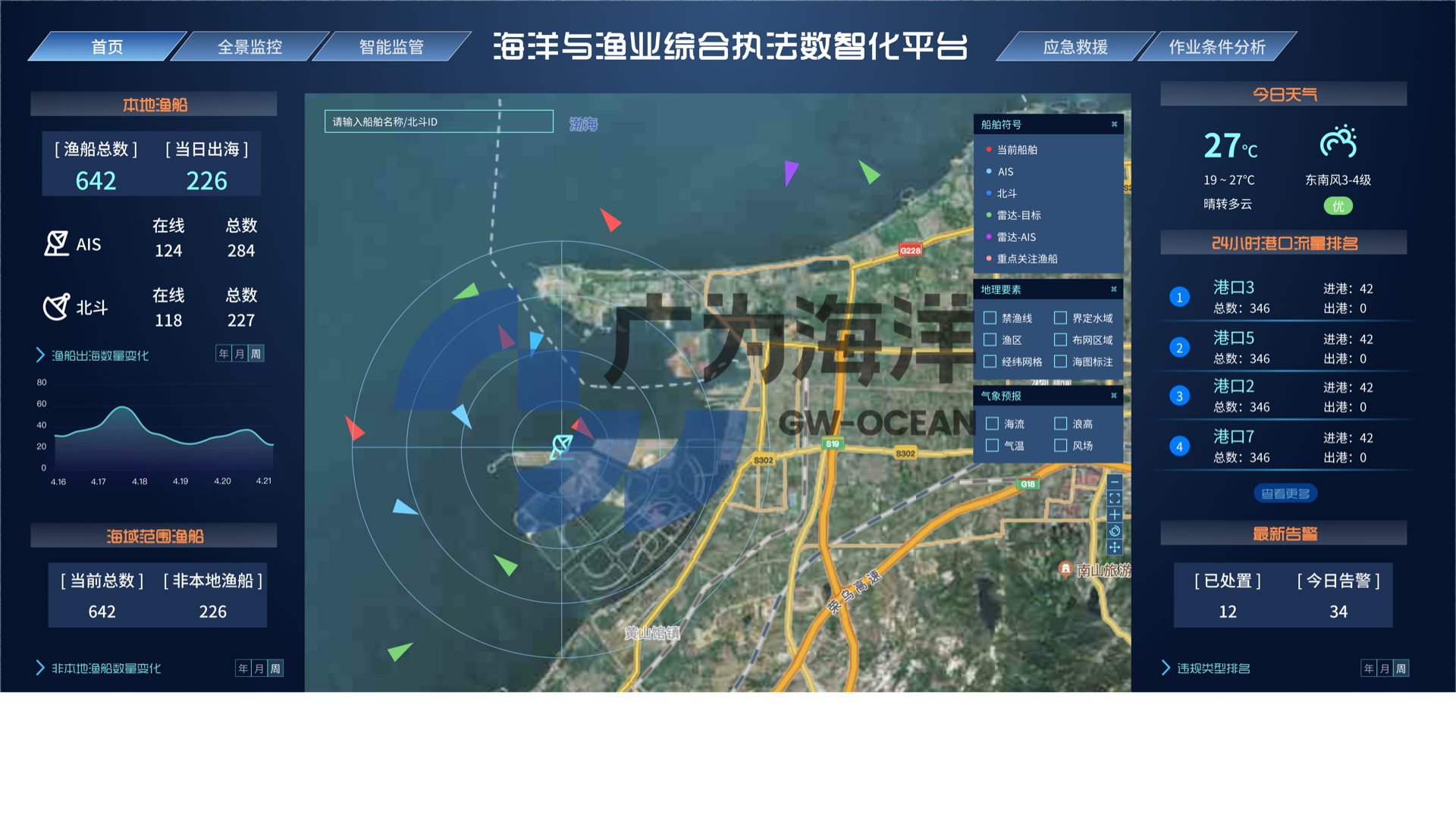
Marine AIS–Radar–Electro-optical Multi-source Fusion Early-warning Platform

Multi-source Fusion Early-warning

The platform integrates multiple perception technologies such as AIS, radar and electro-optics to build an all-weather, all-directional, high-precision system for monitoring and early-warning of dynamic marine targets. Through multi-source data fusion and intelligent analysis, it improves the response capability and efficiency for marine traffic-safety supervision, prevention and control of illegal activities, and emergency-response dispatch.

Selected as a "2025 Yantai Digital-Sector Featured Case".

06 · Smart Reserve Patrol

Smart Patrol Platform for Nature Reserves

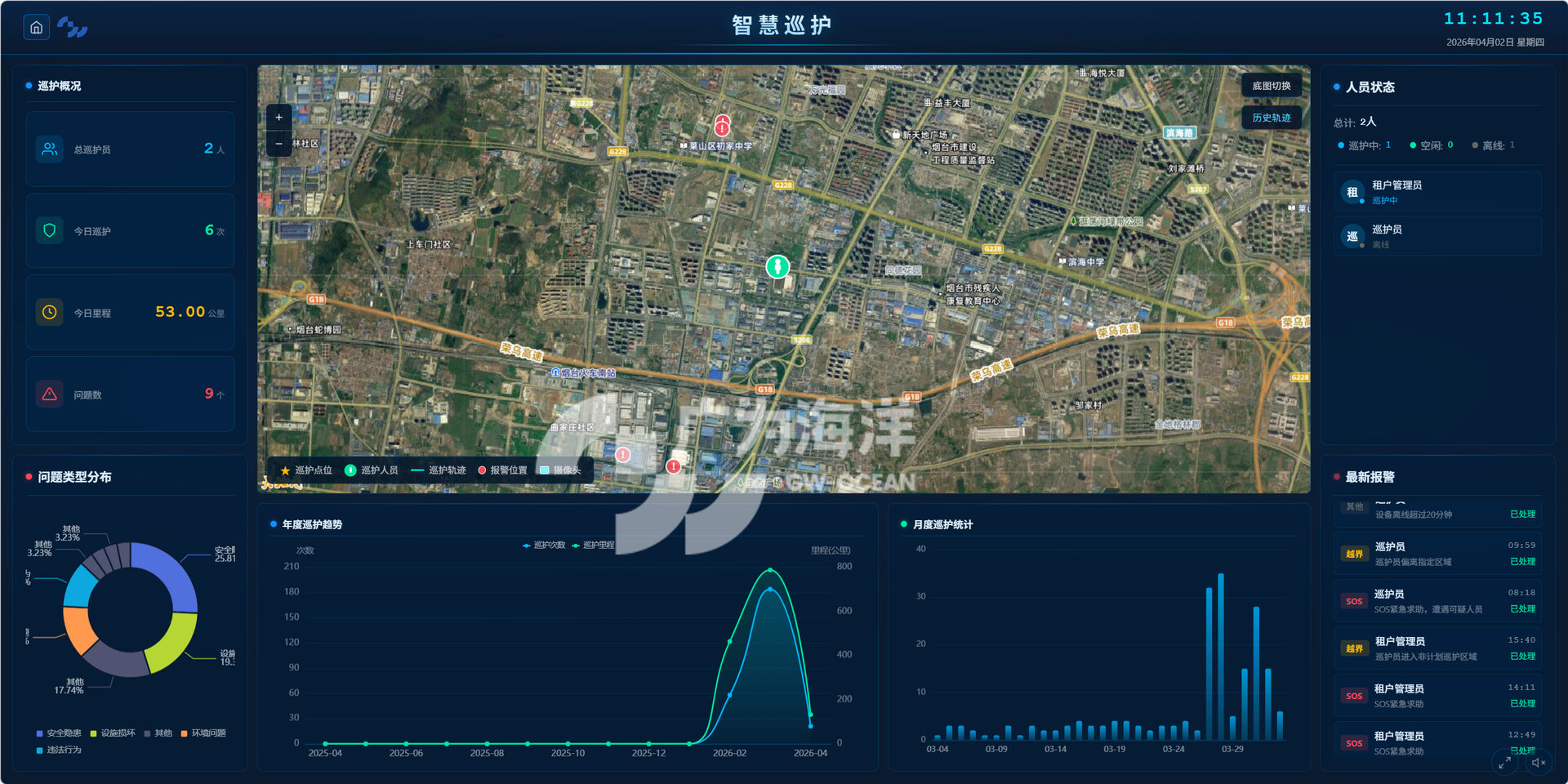
An intelligent management platform developed for challenges such as large reserve areas, long patrol routes and difficult supervision and assessment. It rationally arranges patrol tasks and optimizes patrol routes, enabling resource sharing of the reserve’s environmental information, business collaboration and data analysis — improving integrated management and establishing a long-term mechanism of safety protection for the reserve.

Smart Patrol Platform for Nature Reserves
Smart Patrol Platform for Nature Reserves application scenario

Patrol management

Task setup and shift scheduling, patrol-route daily/monthly/annual logs, patrol-report statistics, and maintenance of patrol points.

Data collection management

Patrol personnel upload observation points or feature points to the platform as text, photos and video with coordinates displayed, promptly recording any issues found.

Alarm management

If an issue or danger is encountered during a patrol, a one-tap alarm or SOS can be triggered.

Field patrol tools

Provides practical field tools such as a compass, level, altitude measurement, flashlight, distance measurement and area measurement.

07 · UAV Marine Application

UAV Marine Applications

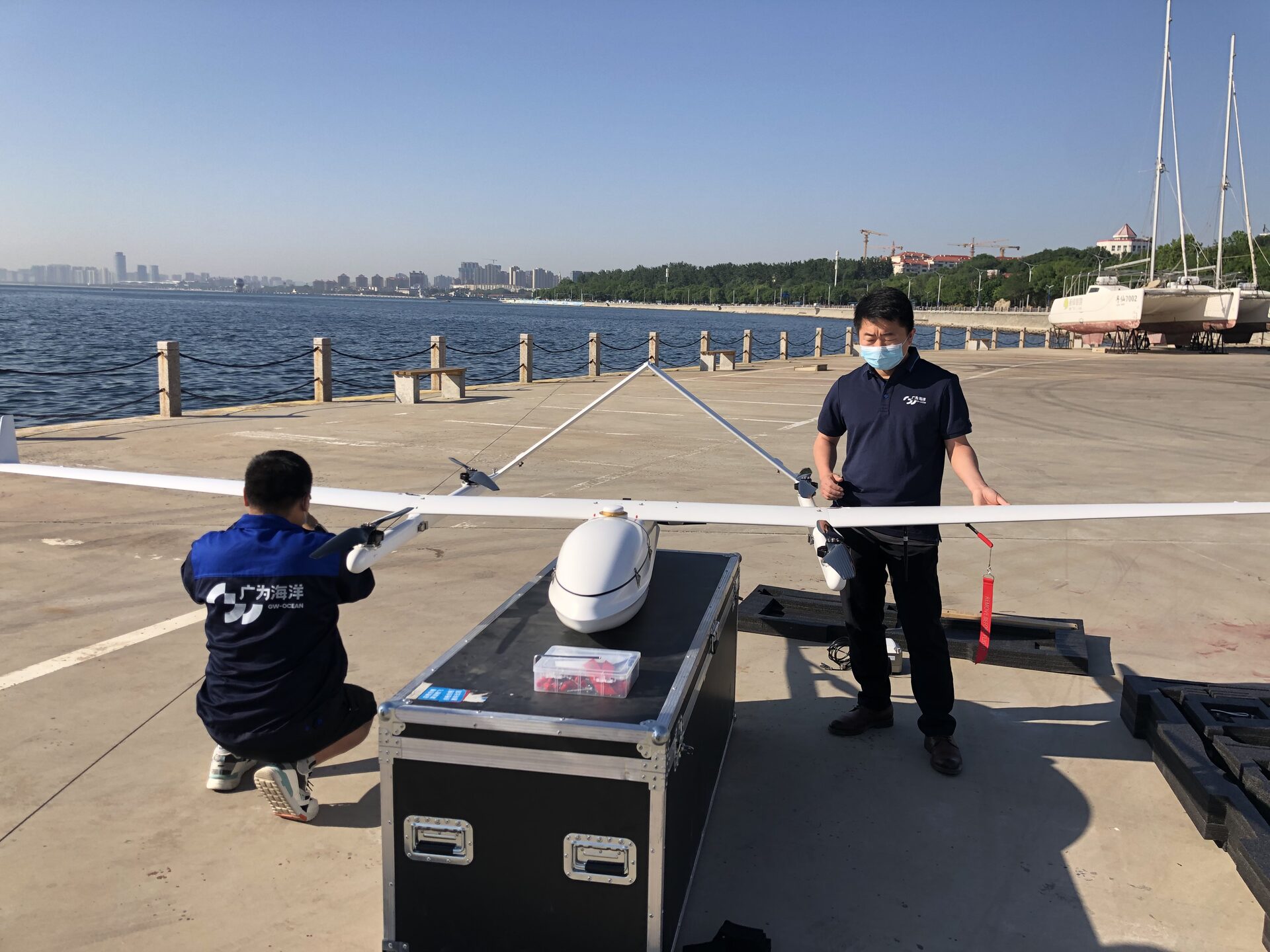
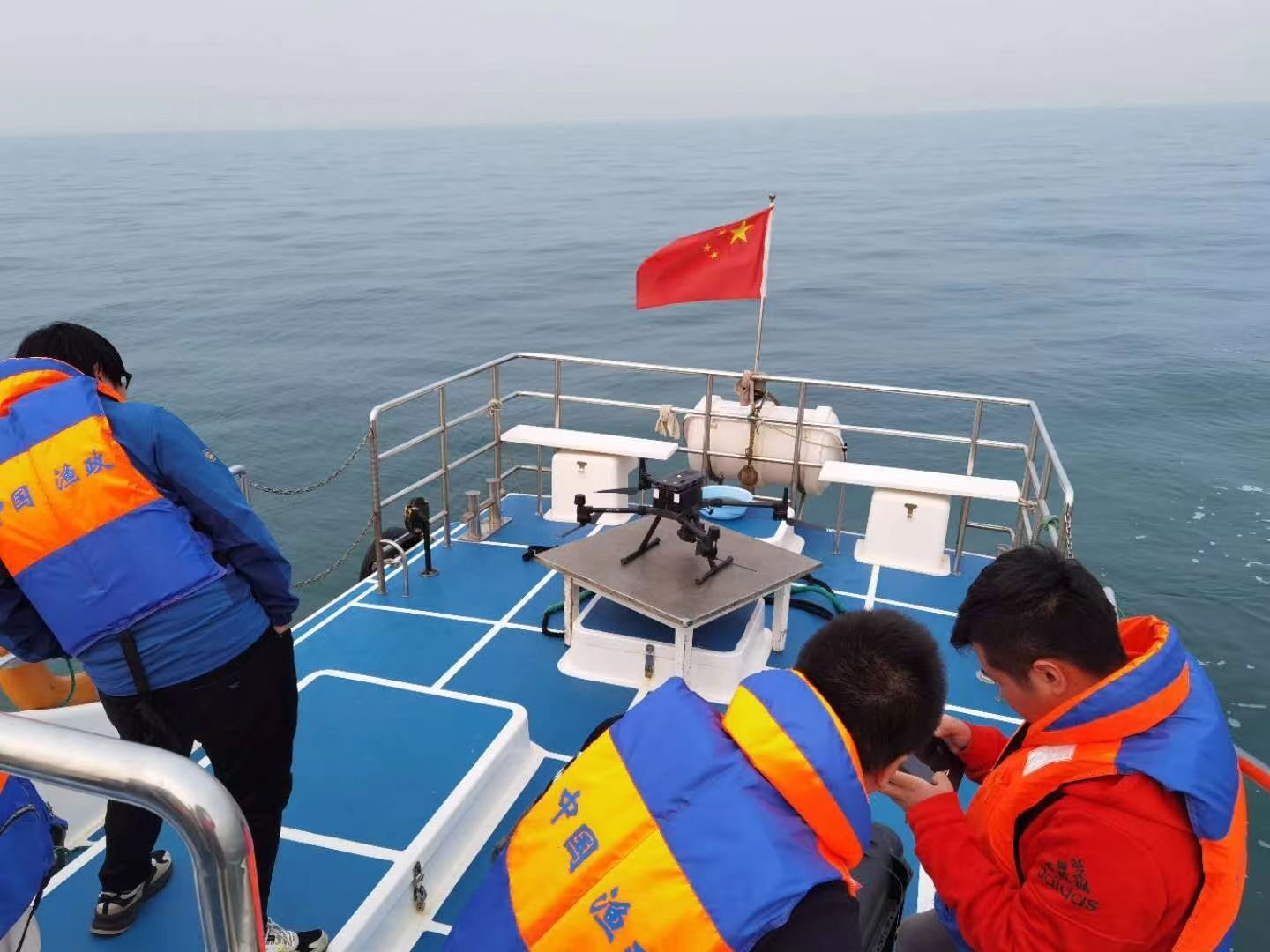
With advantages such as mobility and flexibility, wide patrol coverage, strong wind resistance, simple operation and multi-mission payloads, UAVs play an important role in marine-resource management and planning, marine law-enforcement inspection, marine ecological-environment protection, island-and-reef surveying and mapping, and marine emergency rescue. The company holds a UAV operation-license qualification issued by the Civil Aviation Administration and is equipped with a professional flight team skilled in operating fixed-wing, multi-rotor and VTOL fixed-wing aircraft, offering a full range of services including UAV products, flight services, after-sales operation and maintenance, and technical training.

UAV Marine Applications
UAV Marine Applications application scenario

Marine inspection and law enforcement

Greatly expands sea-area search and surveillance coverage, using target tracking and locking to relay the positions of illegal vessels in real time, and identifying vessel types and locking onto vessel numbers through optical cameras — enhancing enforcement capability.

Island unmanned aerial survey

Integrates industrial cameras, oblique-photography cameras, LiDAR and electro-optical pod video transmission to capture high-resolution imagery and video, precisely surveying island terrain and coastline changes to support resource management and ecological protection.

Marine emergency rescue

In marine disasters and rescues, it leverages rapid response, an aerial overview and mobile flexibility to quickly locate the incident area, search for and identify targets, and complete tasks such as dropping life-saving equipment.

08 · Marine Economy Monitoring

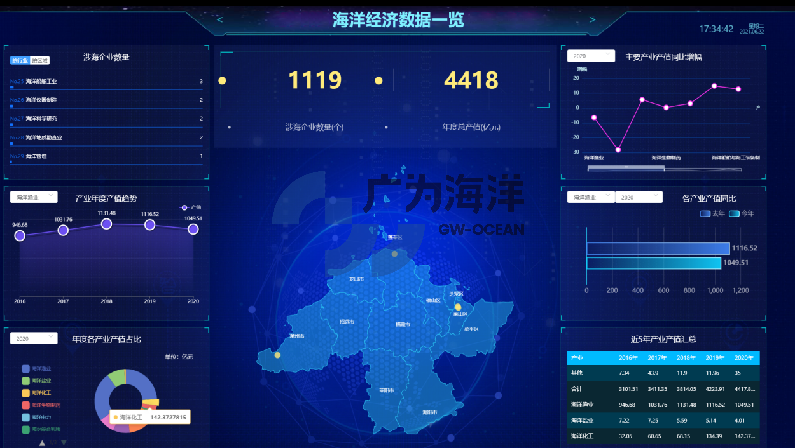
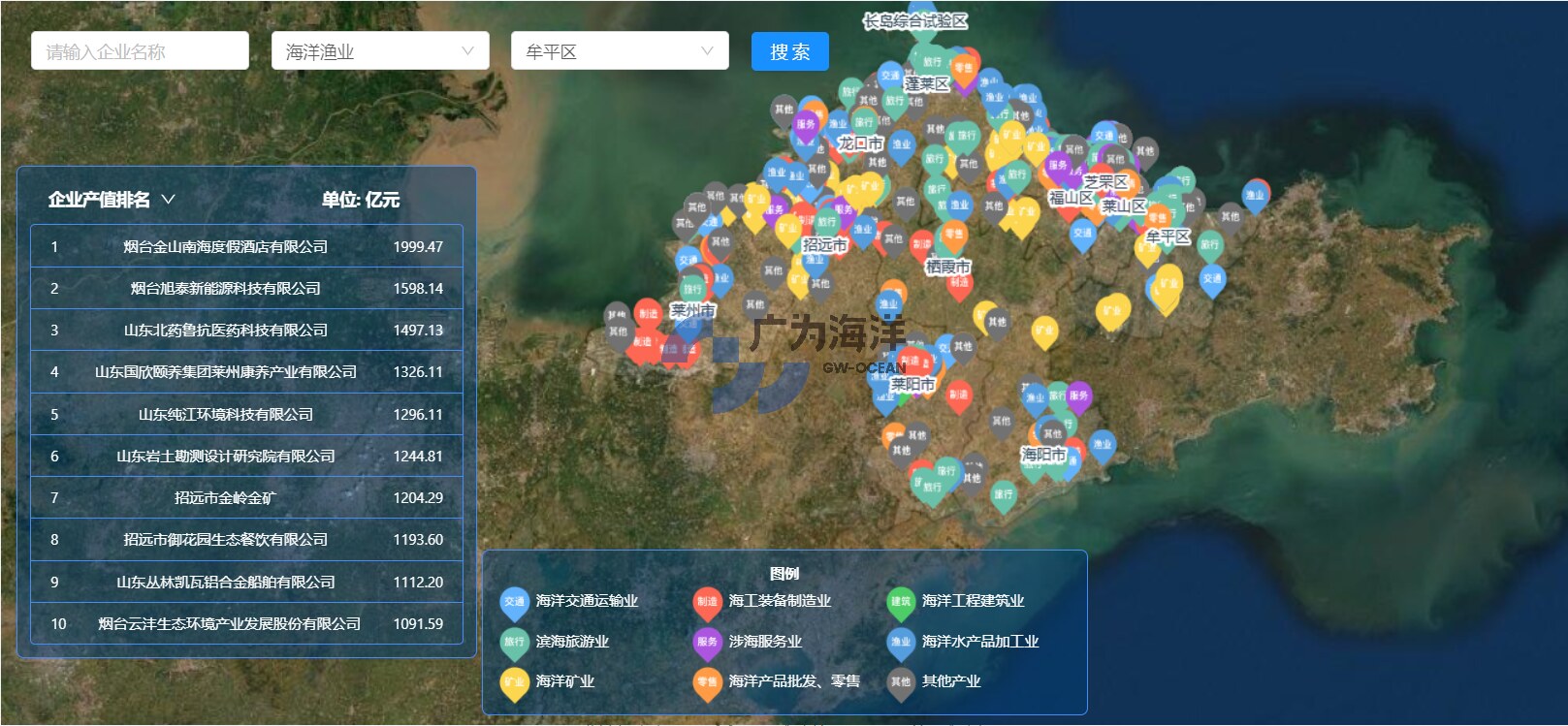
Marine Economy Operation Monitoring and Assessment System

Enables the access and management of marine-economy data within the jurisdiction, visually presenting the real-time dynamics and analysis of the region’s marine economy through statistical charts and electronic maps — achieving centralized display, analysis and assessment-based decision-making of marine-economy data, and improving support for the macro-regulation of the marine economy.

Marine Economy Operation Monitoring and Assessment System
Marine Economy Operation Monitoring and Assessment System application scenario

Marine-related enterprise management

Maintains and manages the basic information of marine-related enterprises within the jurisdiction.

Data reporting and review

Marine-related enterprises report production and operation indicators and marine-product production and services each month, with the competent authority approving and reporting upward level by level.

Data query

Each user can query their own unit’s reported forms, higher-level units can query reported information of enterprises within the jurisdiction, and administrators can query all forms.

Project management

Supervises, reviews and manages the creation, construction progress and construction status of marine-construction projects within the jurisdiction.

Data monitoring and assessment

Aggregates marine-related enterprise information, analyzes production and operation, analyzes marine-economy indicators, and performs economic-monitoring and early-warning analysis.

Marine-economy data display

Aggregates, analyzes and exports marine-economy data, providing an industry map, an economy map and visual displays.

09 · Artificial Reef Monitoring

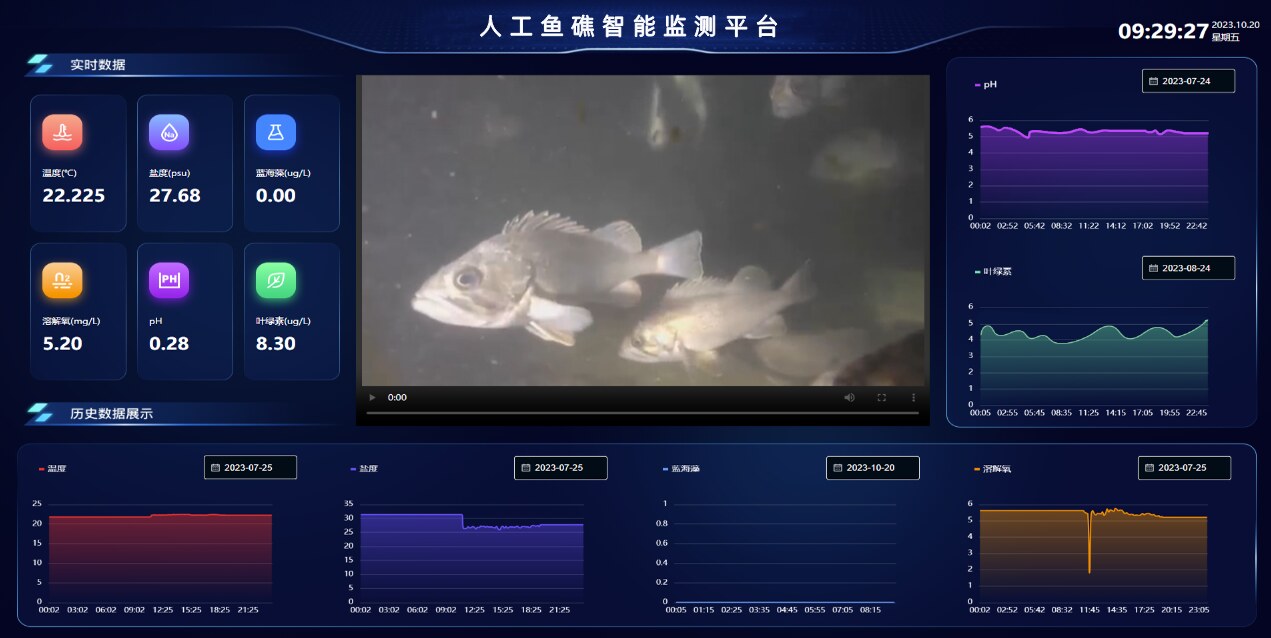
Artificial Reef Intelligent Monitoring Platform

A comprehensive monitoring system developed for the ecological-effect assessment of marine ranches and artificial-reef areas, integrating underwater acoustic detection (fish finder / side-scan sonar), underwater HD video surveillance, multi-parameter water-quality sensors and remote data-transmission modules. It enables long-term continuous monitoring of fish aggregation, substrate change, biological attachment and water-environment factors in reef areas, providing scientific evidence for artificial-reef planning and design, deployment-effect assessment, marine-ranch management and scientific research.

Artificial Reef Intelligent Monitoring Platform
Artificial Reef Intelligent Monitoring Platform application scenario

Acoustic detection unit

Fish finder, side-scan sonar and multibeam bathymetry system to detect fish-shoal distribution density, reef-body accumulation form and substrate-coverage change.

Underwater video unit

Underwater HD camera, fill lights and pan-tilt head for real-time observation of biological attachment on the reef surface, fish activity and the structural integrity of the reef body.

Environmental monitoring unit

Water-quality sensors (dissolved oxygen, pH, temperature, salinity, turbidity, chlorophyll, etc.) capture water-environment parameters of the reef area to analyze the environment’s effect on fish aggregation.

Data acquisition and transmission

A data collector and 4G/5G/BeiDou transmission modules perform multi-source data fusion and relay data to the shore-based platform in real time.

Power-supply unit

Surface-buoy solar power and an underwater junction box provide long-term, stable power for underwater and surface equipment.

Software platform

A data management and analysis system enabling data visualization, trend analysis and automatic generation of effect-assessment reports.

Typical application scenarios
  • Deployment-effect assessment
  • Marine-ranch ecological monitoring
  • Stock-enhancement effect tracking
  • Marine ecological-restoration projects
  • Field observation for research and teaching

Match the right Intelligent Ocean solution to your sea area

Whether for a marine ranch, a smart fishing port, an integrated observation network or coastal radar–electro-optical surveillance, we are glad to explore the path to implementation together with you.