In recent years, global climate change and frequent extreme weather have had an increasingly evident impact on maritime economic activity. Production activities such as shipping, marine fishery, offshore oil extraction and offshore wind-and-solar development have ever-higher demand for fine-grained maritime weather forecasting. Owing to the high complexity and uncertainty of the marine meteorological system, traditional marine weather forecasting struggles to meet production needs in terms of accuracy and real-time performance.
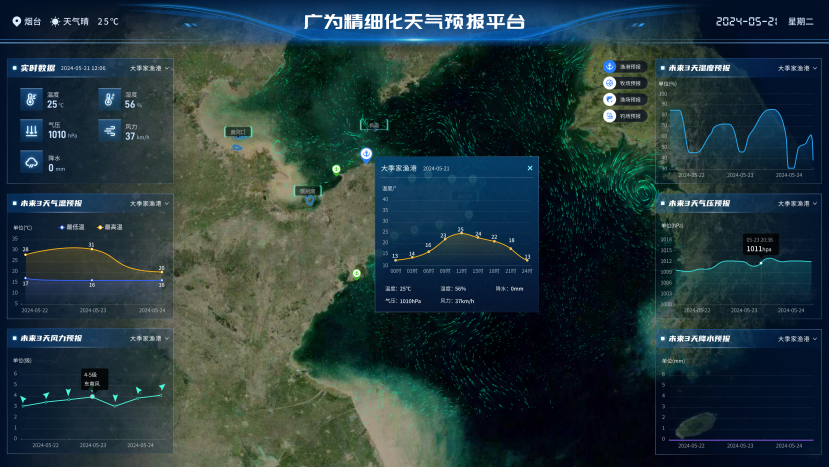
GW-OCEAN’s fine-grained marine weather-forecast large model "Zhihai" combines local weather-station historical data into a model dataset and builds a high-resolution micro-scale meteorological-field forecast model for ocean blocks, providing high-precision marine meteorological services for specific areas. It enables fine-grained sea-surface weather forecasting for target fishing ports, offshore operation platforms and marine-ranch areas, forecasting meteorological parameters such as temperature, pressure, humidity and wind every 3 hours daily; and, using data acquired by shipborne meteorological sensors, it can calibrate every 3 hours daily the hundred-meter-scale micro-meteorological-field forecasts of temperature, pressure, humidity and wind over a marine area.
In the future, GW-OCEAN will also build independent models for micro-meteorological fields of multiple climate zones and, through spatiotemporal multi-head attention, capture temporal and spatial correlations, embedding multiple micro-meteorological-field forecast models into the "Zhihai" large model. This will form a micro-meteorological-field forecast large model applicable to any ocean block in China that, without pre-training, can combine the target sea area’s historical data to effectively analyze and predict marine weather changes and directly forecast the micro-meteorological field of any sea surface; relying on the "Zhihai" large model, users can obtain high-precision marine micro-meteorological fields through simple data fine-tuning.
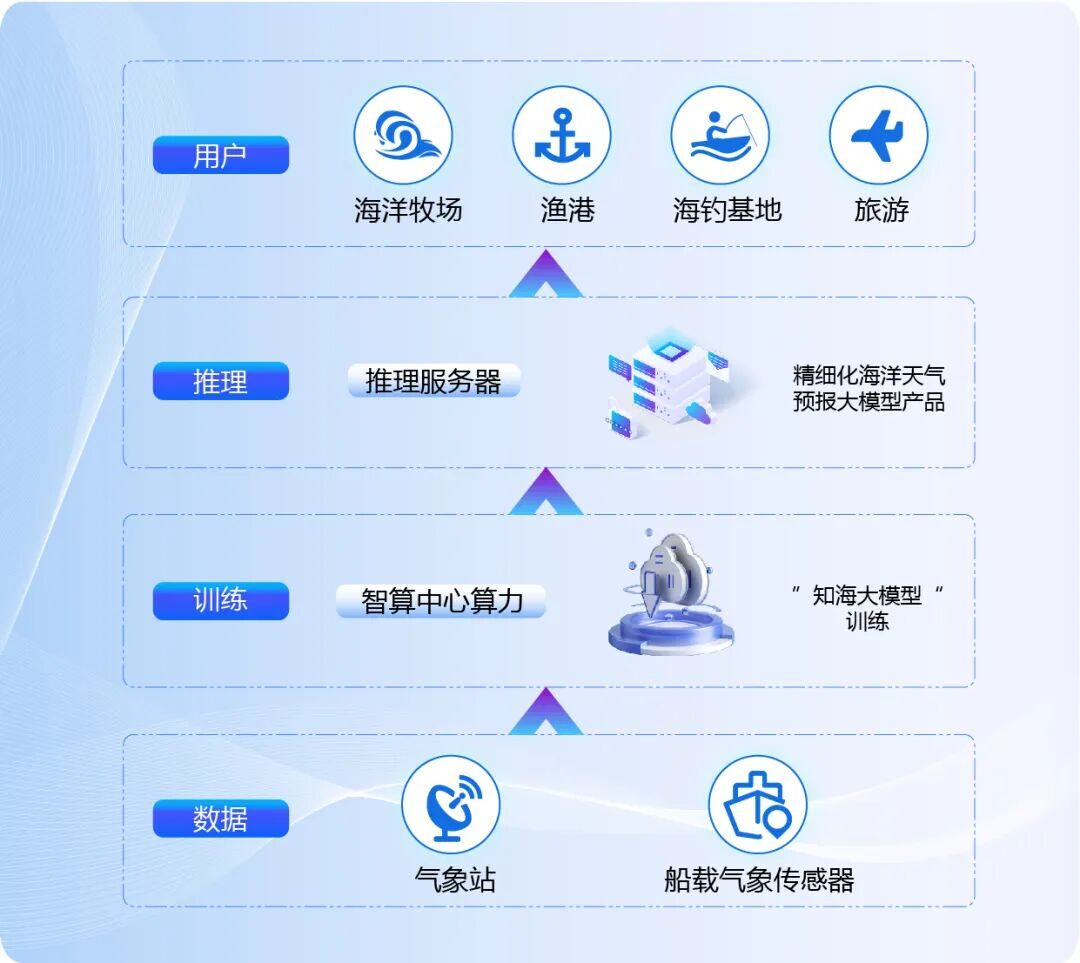
GW-OCEAN’s "Zhihai" large model uses the computing power of a cloud intelligent-computing center to complete the model’s training tasks; the user side only needs to deploy an inference server to use GW-OCEAN’s fine-grained marine weather-forecast large-model product, effectively reducing the cost of use.
The "Zhihai" large model can not only provide users with micro-scale marine weather forecasts for specific areas — offering accurate meteorological prediction for marine tourism, marine-ranch operation, offshore-platform operations and maritime transport, and providing prediction, assessment and emergency-management support for marine meteorological disasters — but can also provide strong data support for research such as marine eco-environment protection and marine climate-change studies. Next, we will collect richer high-quality observation data to improve training accuracy and reliability, continuously optimize machine-learning algorithms to enhance the model’s ability to capture complex weather and its forecast precision, conduct multi-disciplinary cross-validation and model optimization by combining knowledge from meteorology, oceanography and related fields, and actively establish data-sharing platforms with research institutes and universities — jointly advancing the fine-grained marine weather-forecast large model toward greater scientific rigor, accuracy and practicality, safeguarding maritime safety.